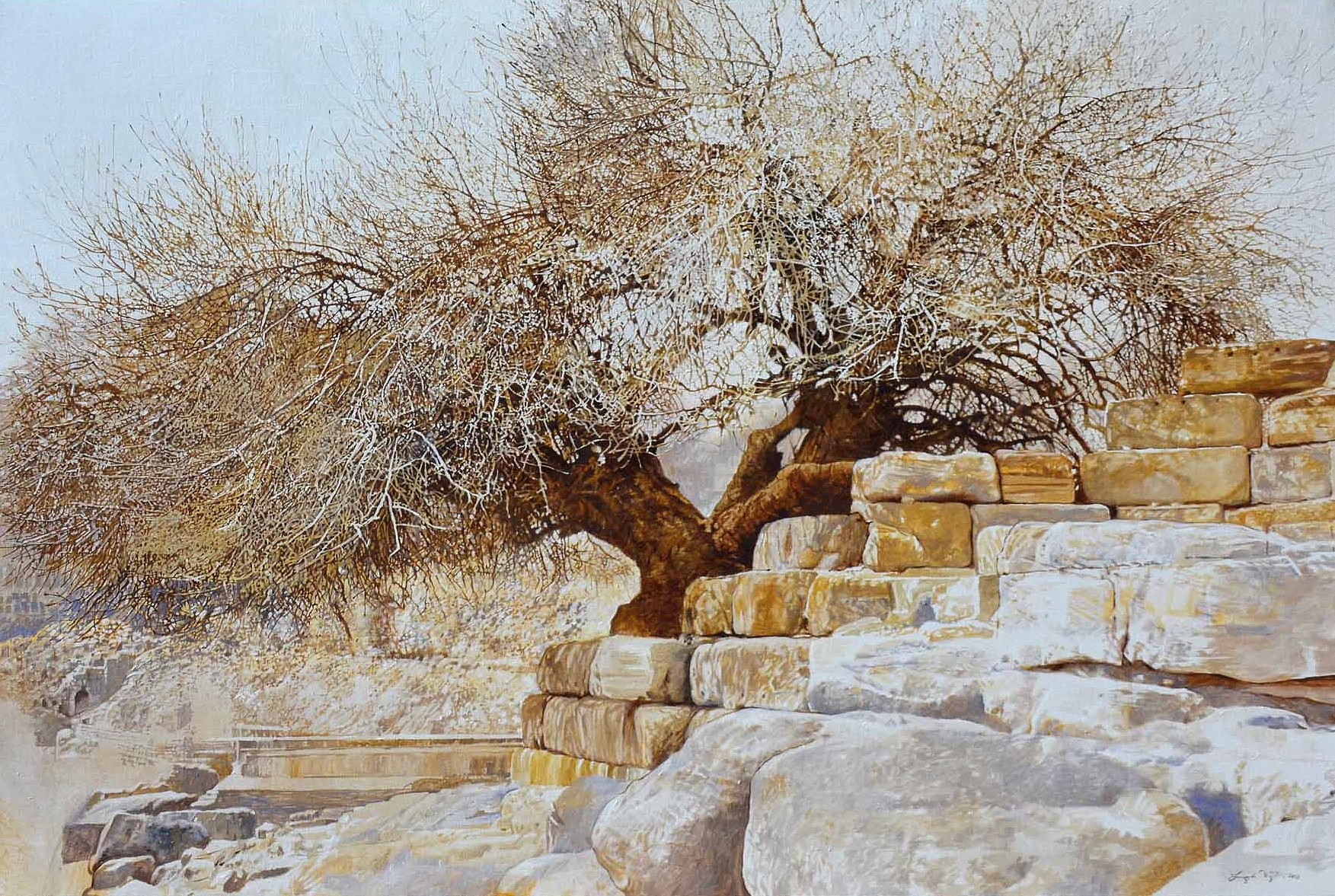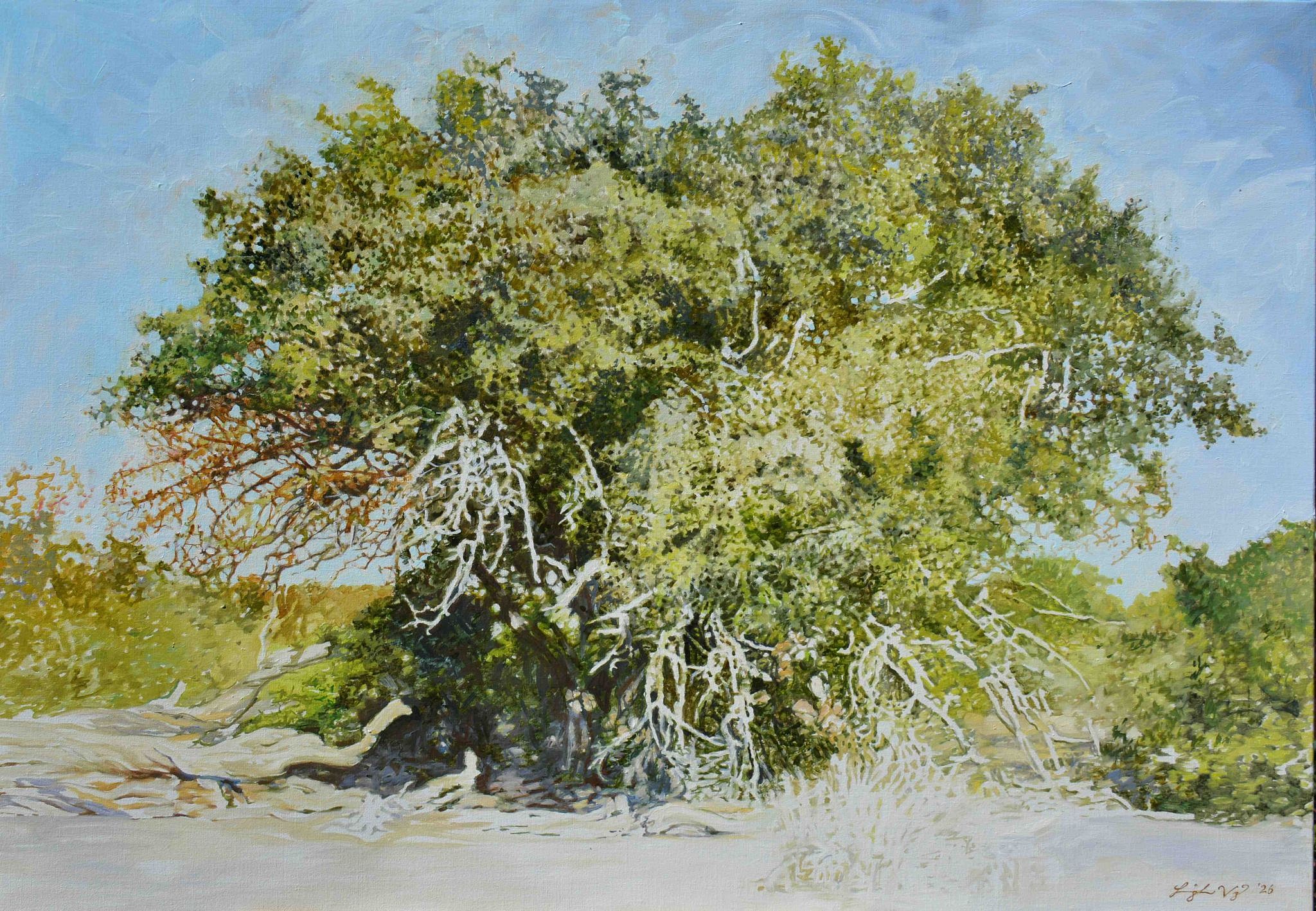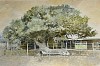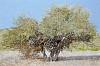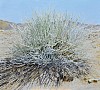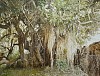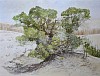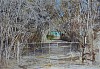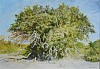
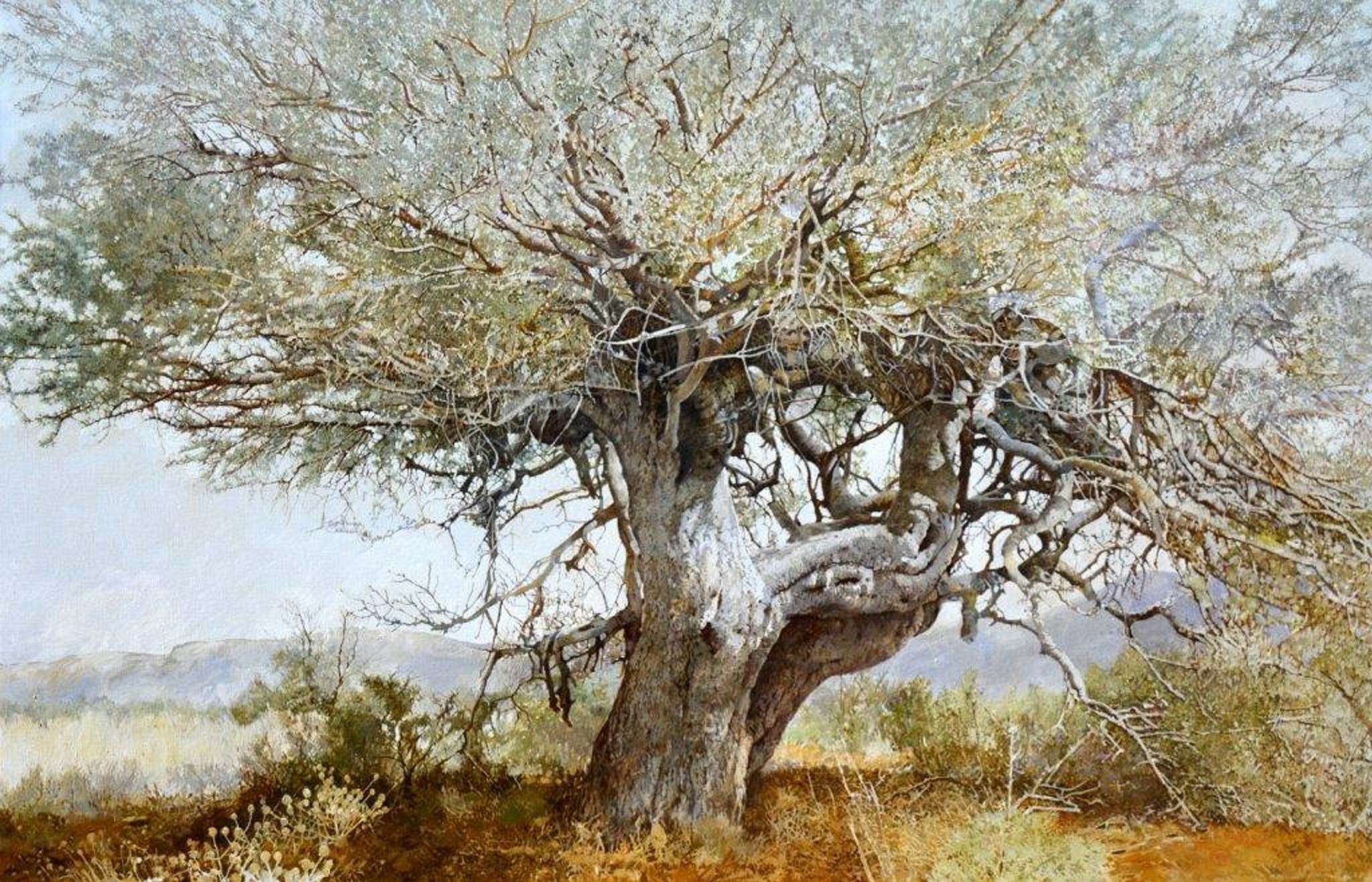
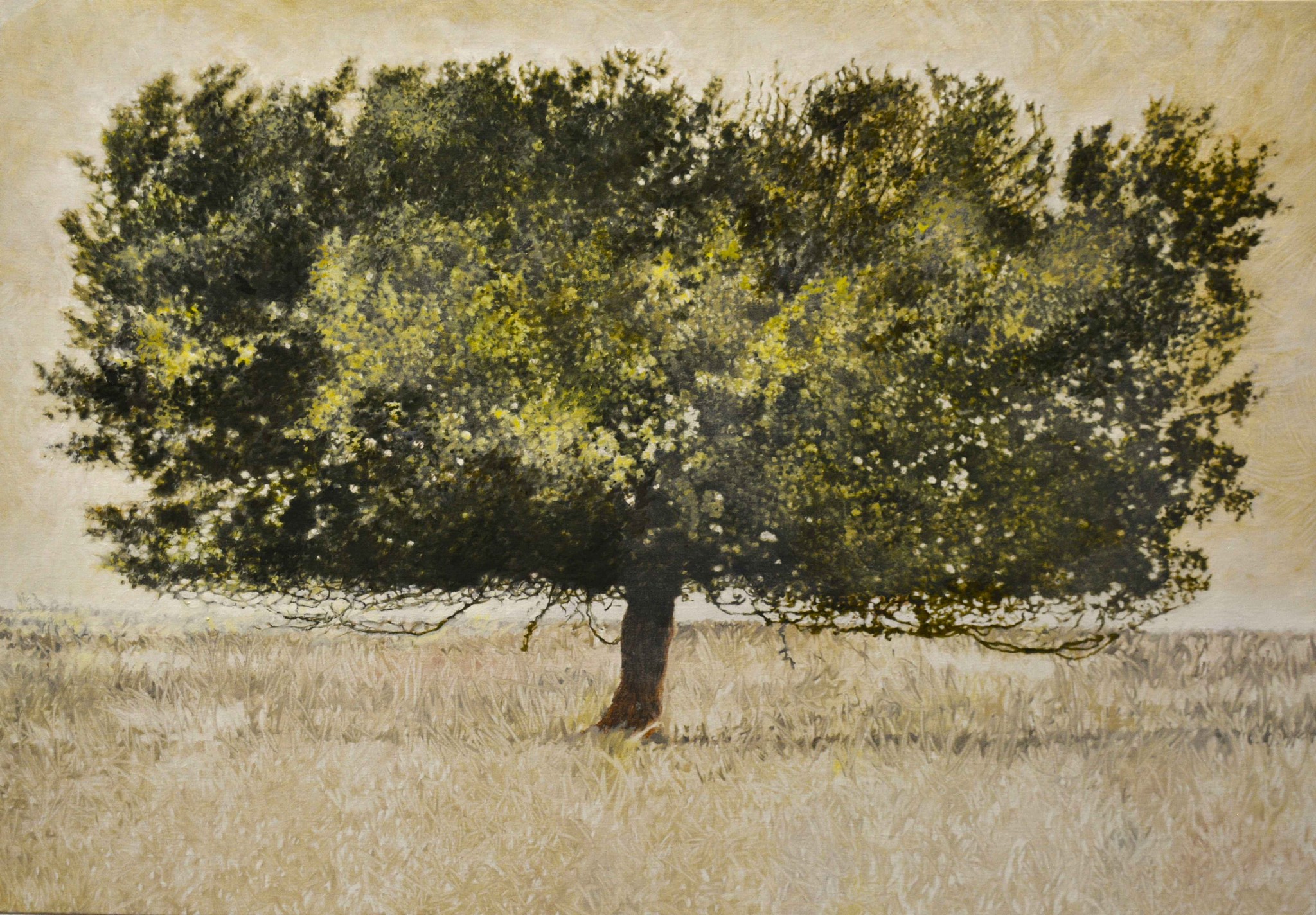
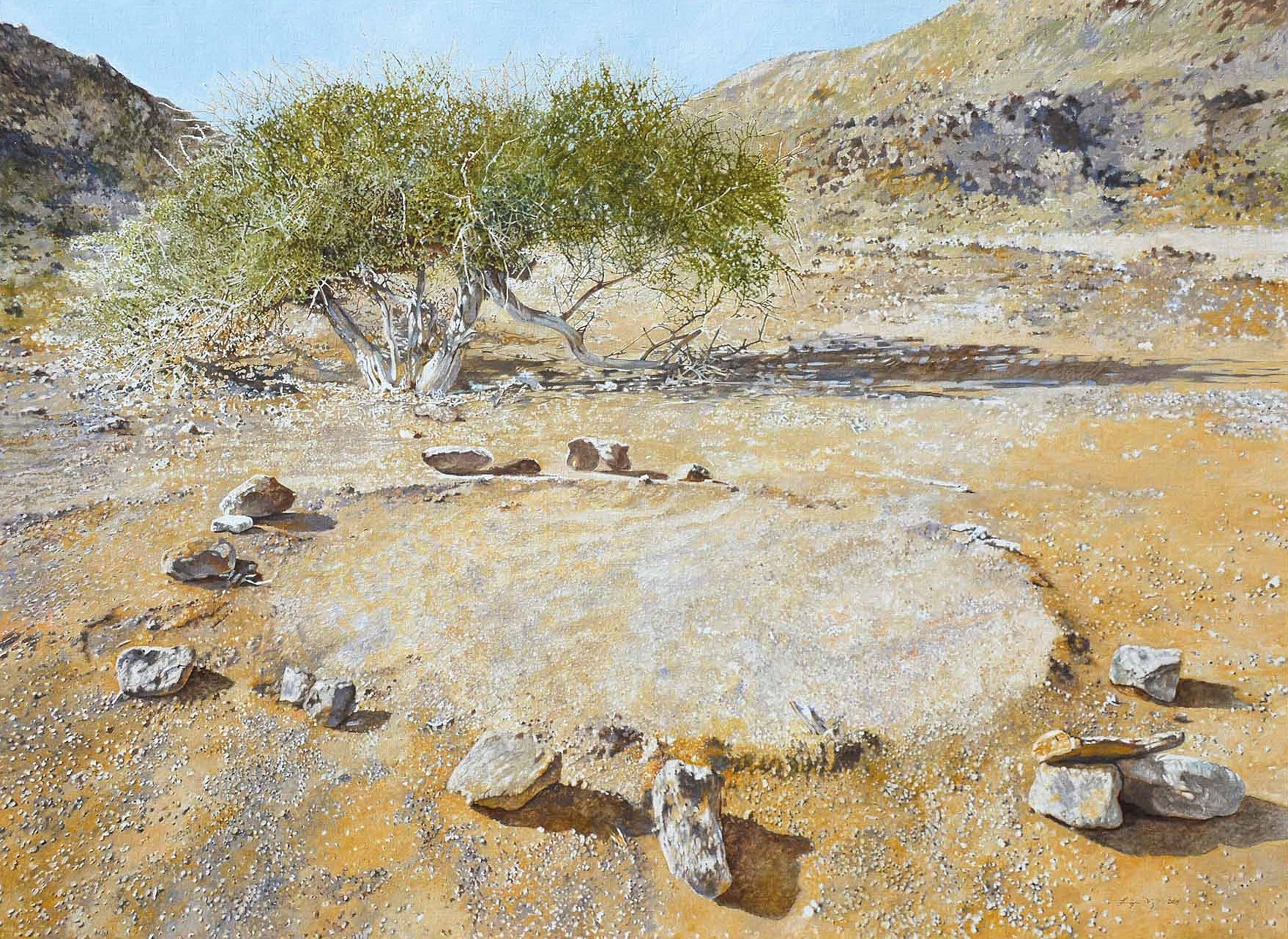
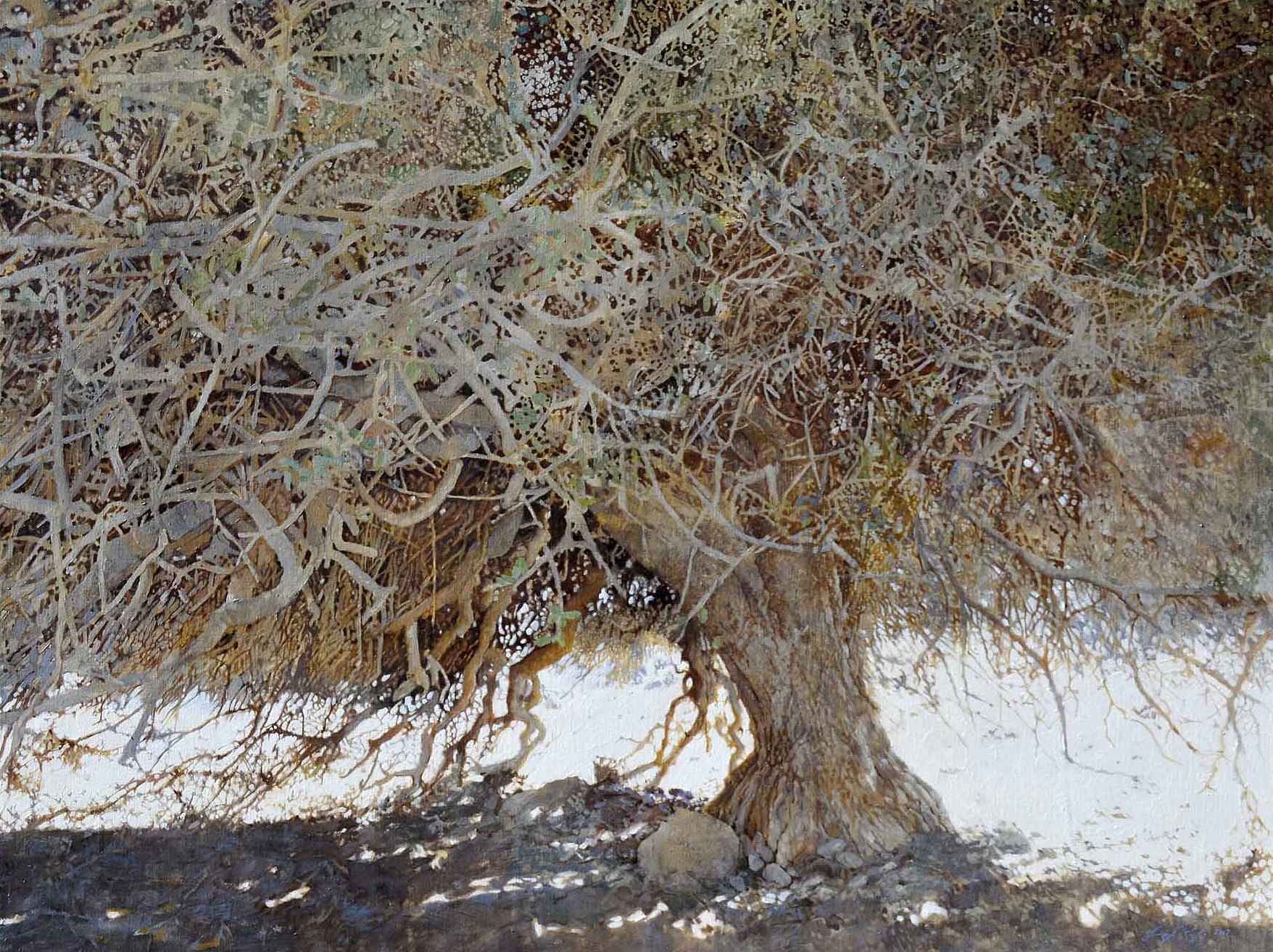
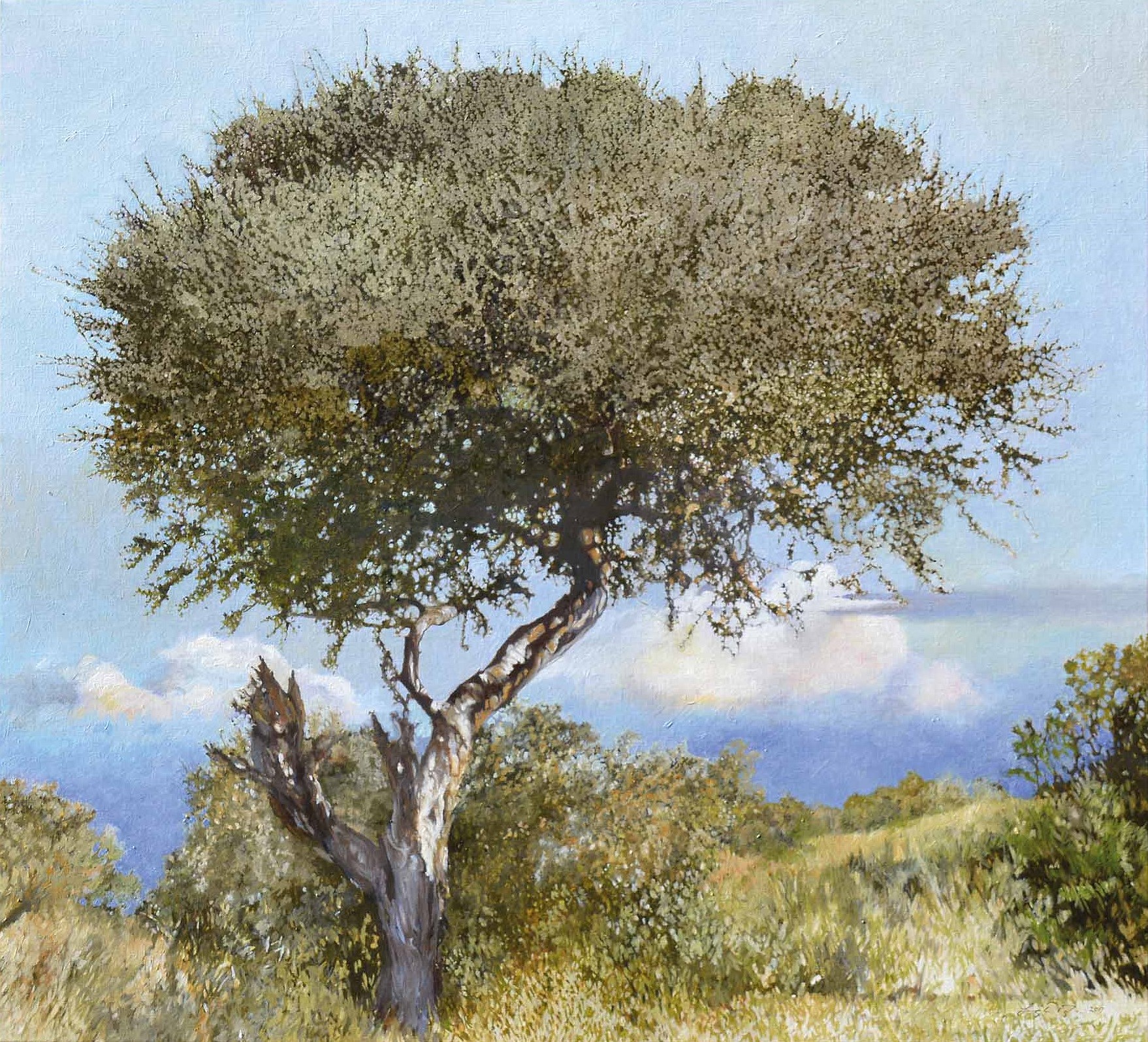
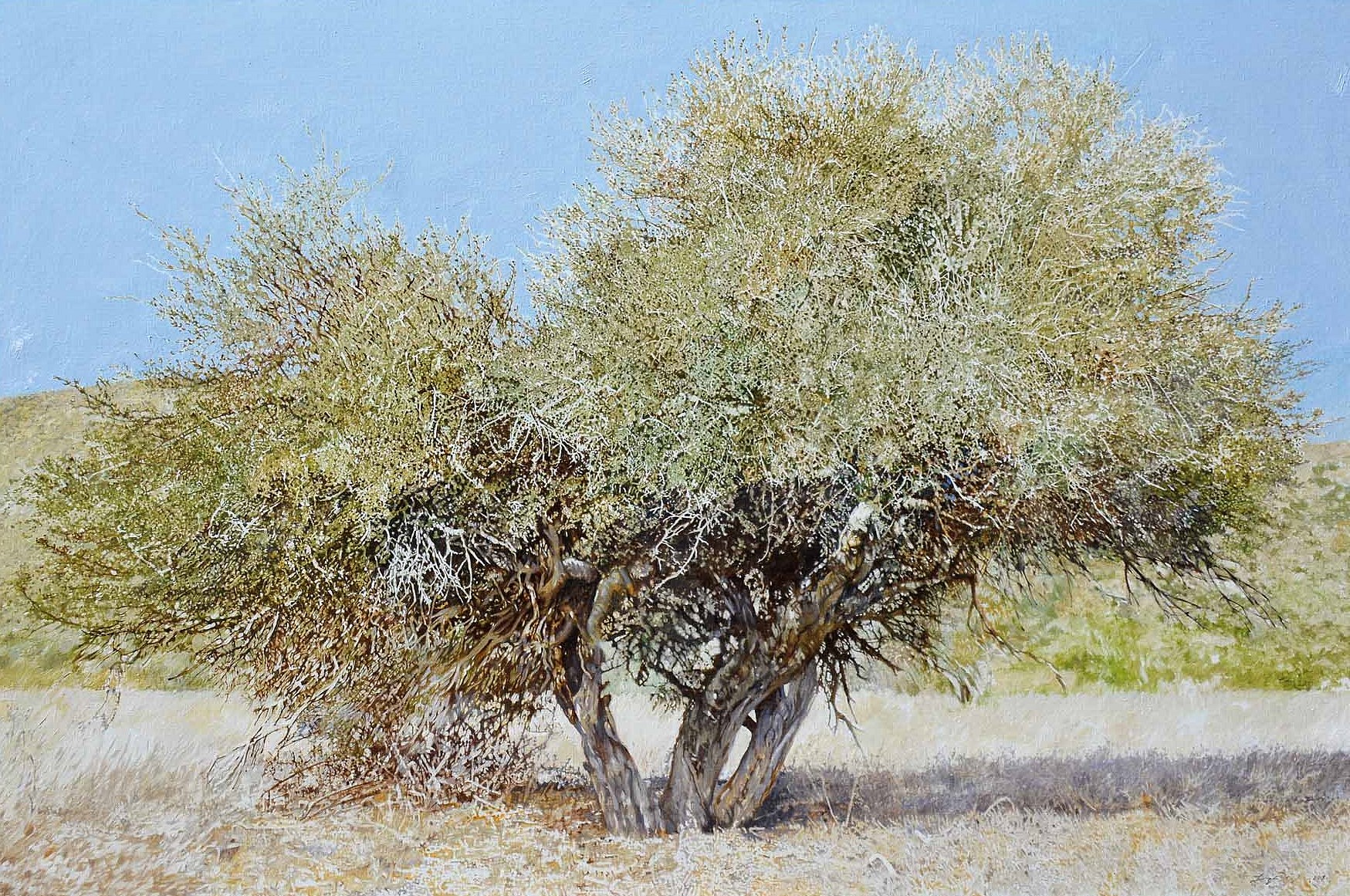
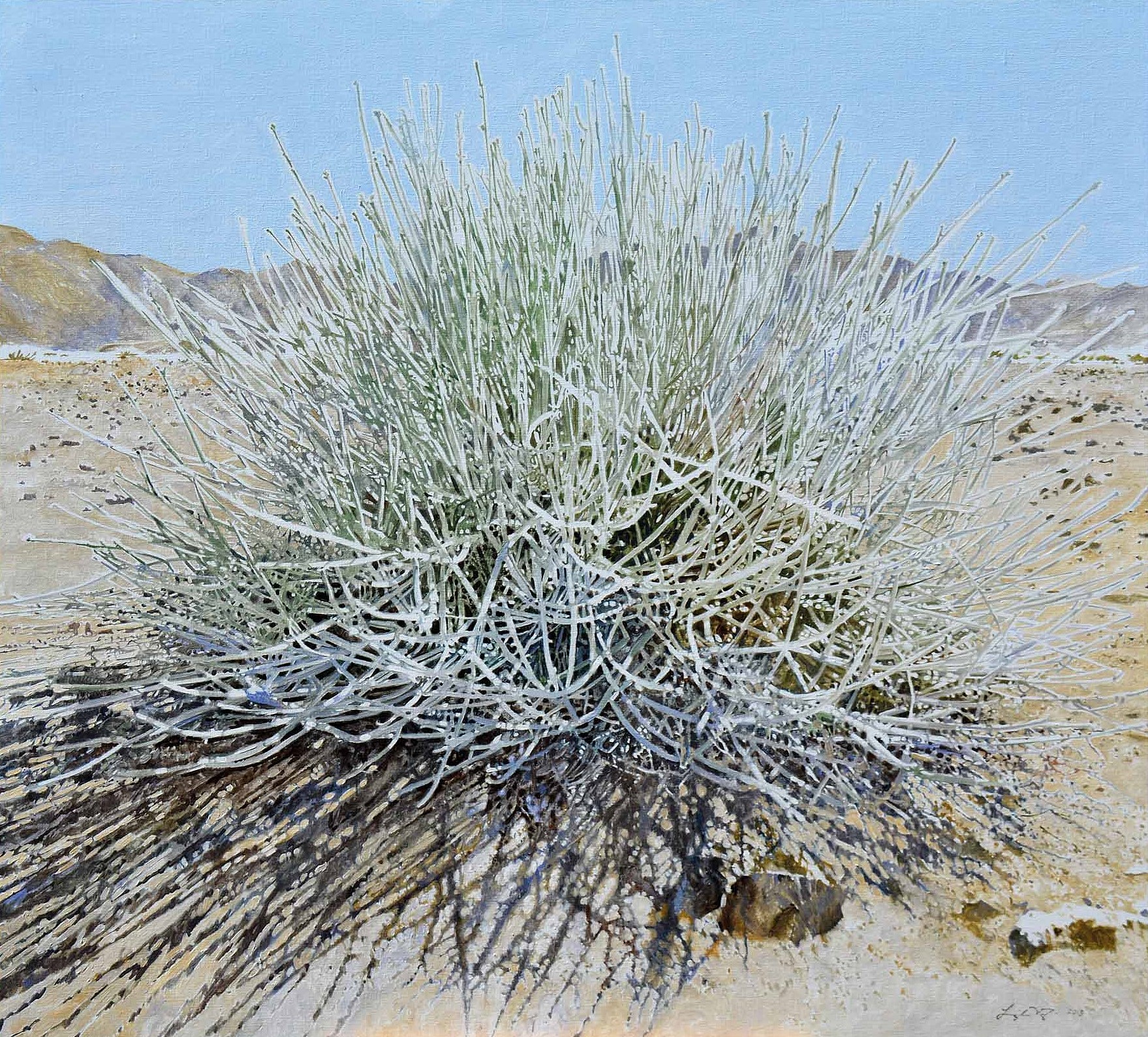
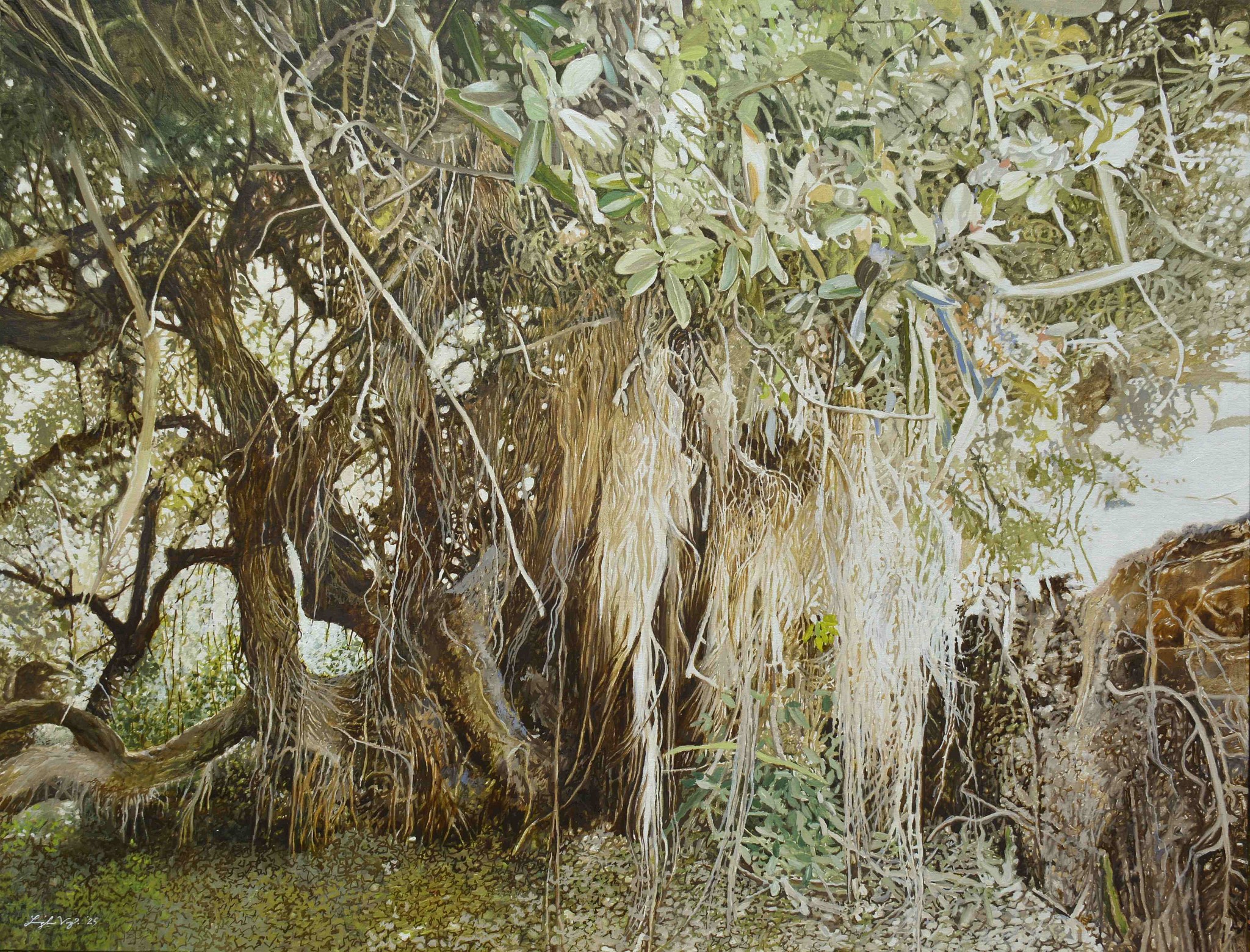
LEIGH VOIGT, Bedford Boscia, Karoo Shepherd's Tree, Boscia oleoides
oil on Belgian Linen, 100 x 150 cm
At first I thought this was Boscia albitrunca, mainly because of its size and therefore its age, but was told, on good authority, that it is B. oleoides. Firstly because of the distribution, being on the farm Olivewoods in the southern Eastern Cape, and secondly, the fact that its flowers have petals, whereas all the other species of Boscia do not.
I first saw this magnificent specimen when I went to the Country Garden Festival in Bedford and was so taken by it, I went back in 2024. It was growing in a goat enclosure and was being richly fertilised. It had fallen over in its youth and the heavy trunk, now horizontal for most of its length had lost its whiteness, due to its accessibility to passing animals as a rubbing post, scratching surface, perch and home to nesting and roosting ground birds. Farmers consider it to be a keeper because of its many uses and the shade and nourishment it provides to all livestock.
A specimen growing on a nearby farm has been aged at 800 years and looking at the density of the trunk and branches I would guess this one to be about the same. Imagine what history it would have been a spectator to. The 1820 Settlers trundling past in their wagons, wars being fought, humans coming and going about their business.
- Leigh Voigt
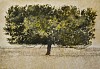
LEIGH VOIGT, Black Wattle, Acacia mearnsii, Ermelo
oil on Belgian Linen, 70 x 100 cm
The Black Wattle is generally persona non grata in this country, an alien, an immigrant, but was extremely useful to the miners of old, doing the heavy work, shoring up the rock face so that underground gold-diggers would be safe from rock falls. It is endemic to south-eastern Australia and would look much better there except when it is shaped in unusual forms and teases the eye into thinking it was meant to be like that. Driving next to an overgrazed farm, out of the corner of my eye I spotted this unusual rectangular-shaped tree. I slammed on brakes, took out my camera, and snapped a couple of photographs. This one, proudly growing on a farm with hungry livestock has generously given up its lower branches to animals of the same height. As I drove a few metres further on and looked back, the tree had become fairly rounded and normal, back to being the accursed invasive Black Wattle.
The reason it is so unpopular in South Africa is that it is considered a noxious weed, threatening native habitats by competing with indigenous vegetation, replacing grass communities and choking natural streams. A. mearnsii competes with local vegetation for nitrogen and threatens our precious water resources.
Another thing that it has done to earn my ire, is that it has fairly innocently committed the crime of being allowed to bear the name Acacia, which any of our indigenous species of Acacia are not allowed to do, and therefore the A mearnsii does not warrant a space on my list of significant trees other than by catching my eye and making me smile.
- Leigh Voigt
LEIGH VOIGT, Daisy's Tree, Milkwood, Sideroxylon inerme
oil on Belgian Linen, 100 x 130 cm
Sideroxylon inerme (White Milkwood) is a hardy, protected coastal evergreen tree native to southern and eastern Africa, prized for its dense shade, fire-resistant properties, and edible, purplish-black fruits. It is slow-growing and highly adaptable, often developing a gnarled, dwarfed form near the ocean and a larger, 15-meter form inland.
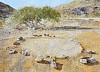
LEIGH VOIGT, Desert Poplar, Populus euphratica, Taklamakan Desert, China
oil on Belgian Linen, 100 x 130 cm
The Taklamakan Desert has an area of 337,000 km2, making it slightly smaller than Germany. Leigh Voigt drove across it. The People's Republic of China has constructed two mega-long cross-desert highways. Sand has been enveloping farms and villages for decades. The Taklamakan is the world's second largest shifting sand desert with about 85% made up of shifting sand dunes, regularly enveloping farms and villages. It was here that she came across the Populus euphratica, or desert poplar. She had been told about these trees and had been longing to see one. They are a symbol of resilience. The saying "live for a thousand years, stand for a thousand years after death, and remain imperishable for another thousand years" is used to describe them.
LEIGH VOIGT, Dusty Road through Winter Tamboti Trees, Spirostachys africana, Lion Sands Game Reserve.
oil on Belgian Linen, 90 x 130 cm
The elegant tamboti tree belies its sinister properties. Beneath and between the closely interspersed trunks, nothing grows, not a blade of grass, not a vine, a creeper nor a common wild shrub. This is known as Allelopathy. The tree can chemically influence the surrounding environment to restrict the growth of other plants.
The tamboti tree, Spirostachys Africana, has a highly toxic milky sap making it unsuitable for braai-wood. Anyone eating something that has been cooked over a tamboti fire would likely suffer from gastrointestinal distress. The leaves and fruit are, however, safely eaten by many antelope, birds and mammals without any problem.
A tamboti grove is one of the most beautiful sights in the well-run private game reserve within the greater Kruger National Park. For close to a century the More/Chalkley family has owned and protected the Kingston Farm, known today as Lion Sands Game Reserve. Across generations, the family has remained deeply committed to conservation, custodianship, and the preservation of this remarkable wilderness - ensuring that Kingston endures as a place of natural integrity and ecological balance.
LEIGH VOIGT, Hazlenut Hedge, Hogsback
oil on Belgian Linen, 90 x 130 cm
Hogsback, in the Amathole Mountains of the Eastern Cape, is both a Hippie Haven and a Horticulturists’ Heaven. Trees of exceptional girth line the roads, which are rutted, muddy, pot-holed and puddled, a sign of unusually high rainfall. One of the first people to settle in the area now known as Hogsback, was Thomas Summerton, a gardener from Oxford, England. He planted apple orchards, avenues lined with Hazelnut trees, rhododendrons and azaleas, all of which grow in profusion. Forestry began in 1883, highly profitable due to the rich clay soil, misty conditions and abundant water.
On one of Leigh Voigt's trips to the charming town, she was particularly taken by the Hazelnut Corylus avellana hedges everywhere and got to thinking about hedges and the psychological importance thereof. They give a feeling of privacy, protection, borders and boundaries. They are a soft gentle reminder that we are human and yet of nature, where a wall might be too strong a statement. They also provide a refuge to little creatures, requiring shade, food and safety from predators. Hedges are comforting.
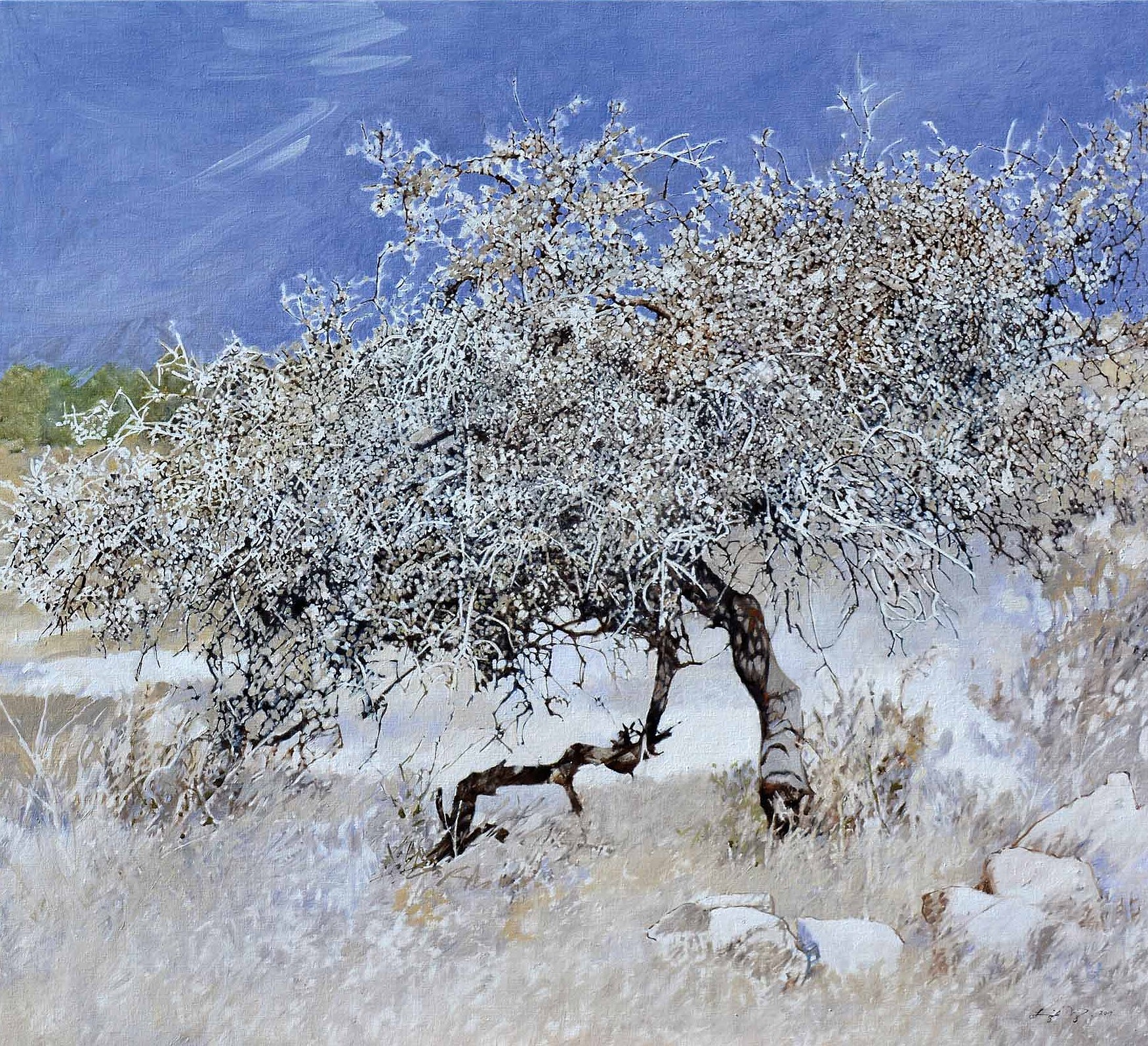
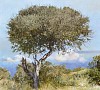
LEIGH VOIGT, Karoo Thorn Bush or Sweet Thorn, Vachellia (Acacia) karroo
oil on Belgian Linen, 100 x 130 cm
The name Acacia is derived from Greek "akis" a point or barb. Karroo is one of the old spellings of karoo which cannot be corrected because of the laws governing botanical nomenclature (giving of names). The sweet thorn gets its common name from the gum which is exuded from wounds in the bark. This pleasant tasting gum is eaten by humans and animals, including the Lesser Bushbaby which feeds exclusively on insects and gum from trees. Like the Boscia, the Vachellia karroo has a long taproot which enables it to use water and nutrients from deep underground; this and its ability to fix nitrogen, lead to grasses and other plants thriving in its shade.
It is also an indicator of sweet veld which is prized for the good grazing and fertile soils. If an area is overgrazed the sweet thorn becomes invasive. Birds also like to make nests in thorn trees as the thorns offer them some protection from predators. Caterpillars of 10 species of butterflies are dependent on the tree for survival. These include the club-tailed charaxes (Charaxes zoolina zoolina) and the topaz-spotted blue (Azanus jesous).
Driving through the aforementioned so-called boring Karoo, to know these little jewels of ecological information makes one ever more in awe of the intricacies of Nature.
- Leigh Voigt
LEIGH VOIGT, Mopane, Colophospermum mopane, after fire, near Mopane Camp, Kruger National Park
oil on Belgian Linen, 70 x 100 cm
The wood of the resilient mopane tree is dense and hard, is oily, seasons well and when fashioned into woodwind instruments produces a warm rich tone. It is used to make excellent clarinets.
LEIGH VOIGT, Spiny Monkey Orange I, Strychnos spinosa, Eastern Cape
oil on Belgian Linen, 100 x 120 cm
Since I seem to have poison on my mind, I’ll follow with one of my favourite trees. Perfectly balanced, the dense crown of glossy dark green leaves sits solidly on a solid trunk until winter when all the leaves fall to the ground. Growing on the beautiful farm, Olivewoods, near Bedford in the Eastern Cape, this magnificent goat-trimmed specimen provides shade for all creatures great and small. The toxicity suggested by the name, Strychnos, is a misnomer because it is used by the Zulus as an antidote for snake bite. It is believed that the presence of strychnine in the bark and unripe fruit along with other alkaloids are responsible for helping overcome the venom of certain snakes, such as the deadly mamba. Strychnine is a powerful central nervous system stimulant that may be able to fight the respiratory malfunction caused by the venom of these snakes.
The indigenous Strychnos is quite safe. It is the South American species S. toxifera and S. nux-vomica from India that one has to avoid.
- Leigh Voigt
LEIGH VOIGT, Spiny Monkey Orange II, Strychnos spinosa, Kruger National Park
oil on Belgian Linen, 70 x 100 cm
In the Kruger National Park it is usual for a car to come to a sudden stop, the driver or passenger having spotted a rhino or leopard or a bird for identification, but for me it can often be just a tree. With the light just right, the shape perfect and the view of it, uncluttered and with more delicate elegance than colour, I reach for my camera before the light changes. I might sit and capture a bit of detail in my sketch book or pull out the tree book and read about it. Luckily, my passengers are usually patient because the joy of the Park is the anticipation that something extraordinary might stroll past the car, and it often does. In fact, the trick is to find a shady side road, turn off the air-conditioner, open all the windows and sit without speaking. Take in the sounds, feel the heat, the breeze, absorb the landscape and breathe deeply. Do the same back in the camp at night. Watch the stars in the clear black sky, a lion roaring in the distance, perhaps on the hunt beneath the very Strychnos now captured on canvas.
- Leigh Voigt
LEIGH VOIGT, Sycamore Fig, Ficus sycomorus, Kruger National Park
oil on Belgian Linen, 100 x 150 cm
This tree earns its place as top runner for the most significant tree of all significant trees. A definite winner.
It qualifies on many fronts especially if you are a bird, bat, a baboon, bushpig or bushbuck, a bush-baby, elephant, duiker, giraffe, impala, kudu, nyala, a primate or pig.
A majestic specimen of the Sycamore Fig can have a trunk girth of over two metres in diameter. Often found along the banks of Southern African bushveld rivers, the fig tree has its roots deep in alluvial sandy soils. It is home, food source, resting place and shade for a myriad of birds, insects, bats and mammals. The smooth yellowish bark distinguishes it from all other trees.
Nature is intriguing because it often breaks its own rules. It is full of exceptions, complications and anomalies. For instance, where all the Boscia species do not have flowers, Boscia oleoides does. The Sycamore Fig goes a step further and has its flowers within its own fruit. Strange though this may be, Nature provides a very good reason: the Sycamore fig has a mutual relationship with a certain kind of wasp. Furthermore each of the approximately 750 species of figs in the world is pollinated by its own species of fig wasp. This tiny little wasp, no more than a millimetre or two in size enters the fruit through a tiny hole and proceeds to lay her eggs in the ovaries of the flowers while pollinating the flowers as she goes about her business. The wasps live for only a few days and have to find exactly the right kind of host fig. This remarkable association is mutually beneficial, nay, essential, so when the figs are at the right stage of development, the trees release a chemical signal, a pheromone, if you will, which will attract exactly the right species of wasp. When one knows things like this, one should become more sensitive to the perfumes one wears, the pesticides one sprays and the fumes of anything us humans disperse into the air and befuddle the intricate relationship between the majestic fig tree and its tiny wasp.
- Leigh Voigt
LEIGH VOIGT, Thomas' Tree, Red-leaved Fig, Ficus ingens
oil on Belgian Linen, 90 x 130 cm
In October 2027, Leigh Voigt had the privilege of taking Thomas Pakenham around South Africa to photograph some remarkable trees for his soon to be published book ‘In Search of Remarkable Trees, On Safari in Southern Africa’. During this trip Leigh had the joy of painting this memorable, Red-leaved fig, Ficus ingens, ingens meaning giant. This specimen, just turning that stunning golden, coppery, reddish-brown, with an indescribable shimmer, grows at the side of a very busy, hazardous tar road, where Thomas Pakenham set up his Linhof camera on a wobbly tripod, put a towel over his head and took his stunning photograph, now immortalised in his book Remarkable Trees of Southern Africa. Normally this tree serves as bus stop for school children, shade for pedestrians on their way to work, women with babies, and many birds, lizards, insects and of course, its own pollinator wasp, Platyscapa soraria.When this tree is in full glamour mode, when the leaves are bright red-brown, with prominent yellow veins underneath looping along the leaf margin, it is utterly breath-taking. No artist, fashion designer or heroin addict could invent something so intangible, so impressive.
Specialists in contemporary art from South Africa. Established in 1913. South African artists are part of the global conversation. We seek to make their voices heard.