PRESS RELEASE
CARYN SCRIMGEOUR | A Certain Slant of Light
Nov 12 – Dec 12, 2026
CARYN SCRIMGEOUR | A Certain Slant of Light
12 November - 12 December 2026
Everard Read London presents an exhibition of new paintings by South African artist, Caryn Scrimgeour.
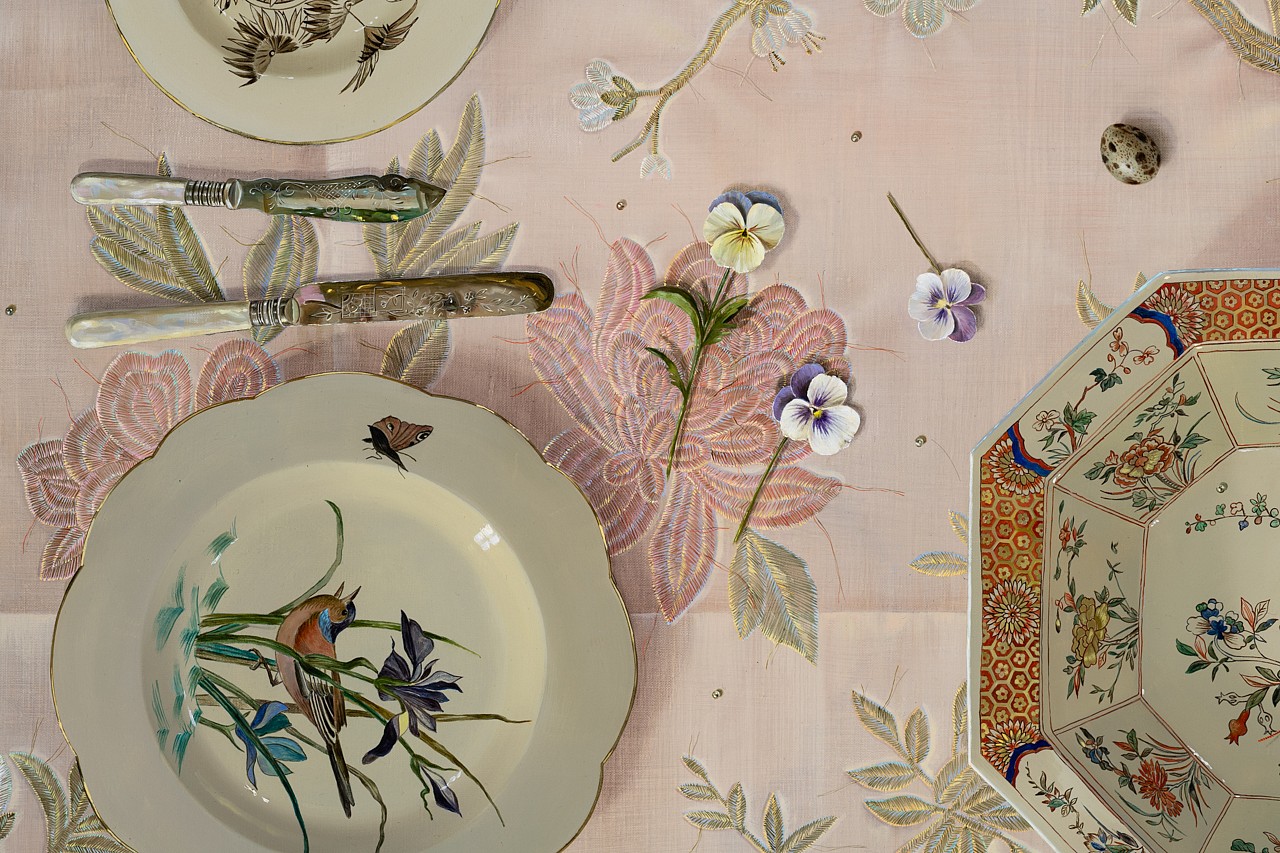
Scrimgeour’s paintings are a manifestation of her intense attention to detail and an extraordinary command of her palette. The artist’s immaculate table settings intrigue and fascinate by juxtaposing fragile and precious keepsakes with everyday objects, each exquisitely rendered.
“There is a light that falls at certain hours, low and oblique, that seeks out the things that often go unseen or unnoticed, revealed only by the shadows they cast,” observes Scrimgeour. “In this body of work, that light moves across silk embroidered tablecloths and ornate porcelain, over pinned wings and ever-watchful birds, over gifts left unopened, torn fragments of paper and loosely tangled threads. It captures the animation of life; of falling petals and butterflies in mid-flight, birds momentarily stilled in their flitting, bees foraging and a fly briefly settling.”
Rich in symbolism, Scrimgeour’s work is reminiscent of still life paintings from the Dutch Golden Age. The artist uses ephemeral objects – butterflies, petals, a glistening fig – to remind us of our transience and fragility. A burnt match, a length of ribbon and a torn postcard are treated with as much fondness and care as bone-handled knives and delicately patterned plates.
Scrimgeour explains further, “These works draw not only on the long tradition of still life, but also on the older, quieter traditions of Classical Chinese and Japanese poetry, where a falling petal or a single bird can hold an entire philosophy. These paintings ask what it means to keep or hold onto things - a specimen labelled after the species is gone, a quarrel fired permanently into the glaze of a porcelain plate, small mementos of a past firmly held onto, as if to capture and preserve the fleeting in a moment of infinite stillness.”
The absence of humans – aside from the artist’s ghostly reflection in a spoon or a fish knife – makes these paintings all the more poignant. They are sublime puzzles, much like our identities – made up of fragments freighted with memories and experience. They are vanitas paintings for our age, their terrible beauty encompassing both the rich complexity of life, as well as its brief and fleeting nature.